Posts

Professor Hartnett

Image
Back in the 1920s when newcomers first arrived at the Rap-Shaw Club camp at Beaver Dam Pond deep in the woods north of the Beaver River, one of the first club members they encountered was a rough-looking fellow, dressed like a bum, noisily cutting the grass in front of the clubhouse. At suppertime a man who called himself Professor Hartnett would appear in the dining room dressed in sartorial splendor and try to convince the guests that he was same man who they met earlier cutting the grass.   No doubt, the befuddled guests wondered, “Who is this oddball?”   Dennis Edward Hartnett was born July 19, 1872 in Catskill, NY, son of Dennis and Mary Ann Byrne Hartnett. His father worked in the local wool spinning mill. His family was of modest means. As soon as they were old enough, he and his siblings also went to work as spinners in the mill. Dennis was born with an artistic temperament and a free spirit that did not equip him particularly well for factory work. Instead, he applied...
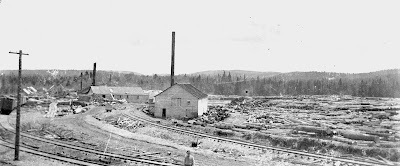
Ouderkirk's Sawmill

Image
Ouderkirk's Mill, c1893, Goodsell Museum collection Where the hamlet of Beaver River Station now stands, there once was a beaver pond behind an esker fed by a brook that plunged in from the west. Below the outlet of this pond the brook met its sister from the south and together they flowed into the mother stream that we now call the Beaver River. On the south branch close to where the two streams merged there was a spring hole with a sandy bottom filled with native brook trout. The area around the confluence of the two streams was a large marshy meadow filled with native grasses and shrubs. In 1891 and 1892 a trans-Adirondack railroad was built through this area. It originated at a junction with the New York Central Railroad main line in the Mohawk Valley and reached north to Malone near the Canadian border, thus it was originally named the Mohawk to Malone Railroad, or the M&M for short. The railroad was designed and financed by Dr. William Seward Webb. Only a year after train...

Rufus J. Richardson

Image
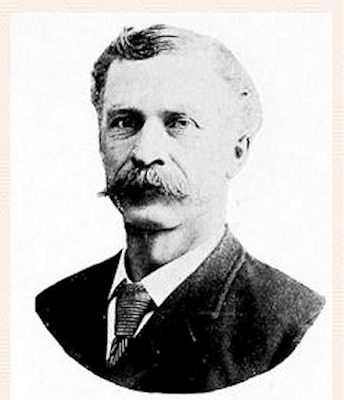
  “Hello, is this Ed Pitts?”   “Yes, it is. Who’s calling.”   “This is Joe Reeder. I have a camp near the Stillwater Reservoir. Does the name Reeder or Richardson mean anything to you?”   “I can’t say for sure. Richardson rings a bell but I’m not sure I can place Reeder.”   “Thought so. I’m calling because I read your book on the Beaver River and I’m surprised that you didn’t mention my camp. I believe it’s probably the oldest continuously occupied camp in the whole Beaver River area.”   “Really? I’m sorry, Joe. I remember now that Terry Perkins once told me I should investigate the history of your camp, but I never got around to it. To be honest, I had the impression that it was just a typical hunting camp. I’d be very happy to look into the history of your camp and, with your permission, write about it on my blog.”   “Why don’t you come up to visit? I’m at camp right now. I’ll be here through the first week of November.”   A week later, with my ...

Magneto Telephones

Image
So far as I can tell, the first documented telephone service in the Beaver River country started in 1891 when William Morrison, a Lowville druggist, financed a telephone line to connect the Smith’s Lake Hotel that he owned at today’s Lake Lila with his store in Lowville. This allowed guests arriving in Lowville by train to alert the hotel and allowed the hotel to order supplies from town. Even given the significant cost, the phone line must have been a welcome improvement. Since the railroad through Beaver River did not yet been exist, a trip to town took at least two arduous days by boat and wagon. Morrison’s telephone connection functioned like an intercom. The wire was only able to connect two telephones. Such systems were popular despite this limitation. They were commonly used to connect businesses to one another, or to connect a person’s business to their home. The signal could carry over long distances making it practical in many applications. The draw-back was that every pair o...

Stories from Etta Kempton’s Journal, Part 4 – Gladys, Beaver River Teenager

Image
  Gladys in the doorway of the Beaver River Station Try to imagine the life of a teenage girl in Beaver River in the early nineteen teens.  There was no school there at the time and consequentially no school sports or other school activities. There was no telephone, so the only way to communicate with friends and family was face-to-face or by letter. There were no automobiles, so the only way to travel was by walking, horse and buggy or railroad. Popular music was supplied by a wind-up Victrola playing a small stock of 78 rpm records. There was no radio. Television and the internet had not even been imagined. In short, there were none of the things that teenagers take for granted today.    Such was the world of Gladys Kempton. Gladys was seven years old when she moved to Beaver River Station in 1905 with her mother and father. She had been born on August 14, 1898, presumably on Etta’s parents’ family farm outside of North Bangor near the town of Brushton, St. Lawrenc...