Posts

Dave and Mabel Conkey

Image
The old-timers at Beaver River Station remember Dave and Mabel Conkey as something of a legend. They arrived about 1907 to establish a sportsman’s camp on the point that sticks out into the outlet of Big Burnt Lake on the north side of the Beaver River. They ran a camp at that location until they were evicted in 1916 [see my post of 06/05/21], then relocated into the settlement of Beaver River where they continued to host and guide visiting sportsmen into the early 1950s. Later in life, the Conkeys lived at Beaches Bridge just outside Lowville in the winter months, returning to Beaver River with warmer weather. In their fifty or so years at Beaver River they saw the community change from a way-station in the wilderness to the boom town of the 1920s then morph into the private camp community it is today. Few others have ever lived there so long. David Lysander Conkey was born on Nov. 8, 1870 in Petrie’s Corners, Town of Watson, Lewis Co., NY. His parents were Emma Graves and John Lysand...

William Prevost Goodelle, Esq.

Image
William Goodelle was a well-known and well-liked Syracuse attorney who lived at the end of the 19 th   and beginning of the 20 th   centuries. He rightly deserves to be remembered as an outstanding trial lawyer, an early leader of the local bar association, and a person dedicated to setting and maintaining high standards for the legal profession. He also deserves to be remembered for adding one important word to the “Forever Wild” clause of the New York State Constitution. Early Life William P. Goodelle was born on May 25, 1838 on a farm in Tully, N.Y. just south of Syracuse. His parents were Aaron B. Goodelle, a successful farmer, and Eleanor A. Prevost. After obtaining his elementary education at the local common schools, he attended the Homer Academy for a year, then completed the five-year college preparatory course at the Cazenovia Seminary. In the spring of 1861, he enrolled as a sophomore at Dartmouth College and graduated with the class of 1863 with high honors. When h...

In their own words #6 – Raymond G. Hopper

Image
After deriding the expansion and gentrification of most hotels across the Adirondacks, Hopper’s article praises Smith’s Lake because it had remained in its untouched “primordial” state. Hopper feared that railroads would soon penetrate all parts of the forest. As a result, Hopper warned, the wilderness “is fast being brought into narrower limits by a ruthless inevitable march of civilization.”   Hopper concluded his article with the urgent and ultimately ironic advice to other sportsmen to “go there!” Hopper had no way of knowing that by the time his article was published it would already be too late for the general public to go to Smith’s Lake. In early 1891 Dr. Wm. Seward Webb purchased tens of thousands of acres surrounding the upper Beaver River and tightly closed them off to the public [see my post of 10/29/21]. Webb also purchased and demolished both Lamont’s and Muncy’s hotels. The railroad that Hopper feared, cut diagonally across the area. [see my post of 04/27/21]   ...

In their own words #5 - July 20, 1888 letter from SHL

Image
A rare find, this excerpt from a private letter sent from Lamont’s Smith’s Lake Hotel was discovered recently by Tim Mayers and graciously shared with me. The letter was simply signed with the author’s initials, SHL. There is no indication of the identity of the recipient except that his first name was John.   It is included here because it gives an unstudied account of daily life at Lamont’s. More information on the Smith’s Lake Hotel is in my post of 04/11/21. My dear John,   I seize is this opportunity to send you a note by a man who is actually going to a railroad town to-morrow. You will be delighted to know that this is a place 40 miles away from a RR in a direct line; consequently, deer are plenty & the woods unbroken. I have often thought how you & George would enjoy the hunting, but the poor boy, is debarred, as it seems to be a man’s place exclusively. Don’t let it seem a contradiction when I tell you that for 10 days I have resolutely excluded from contempla...

In their own words #4 - William F. Morris

Image
Local newspapers also printed enthusiastic stories of Adirondack trips penned by sportsmen. This one was suggested to me by Stillwater and Baldwinsville resident Jim Fox. It not only provides a good description of how to make a trip to Smith’s Lake but also vividly illustrates how the interests of tourists gradually broadened from fishing and hunting to include an appreciation of the natural beauty of the wilderness.   The author,  William F. Morris,  was the owner of Morris Machine Works. In 1887, the year this article was written, his company was the largest employer in Baldwinsville, NY. The company manufactured pumps of all kinds and shipped them nationwide on the nearby Erie Canal as well as by rail. The company continued to manufacture its pumps in Baldwinsville until 1981 when the company was sold to the  Gould Pump Company in Seneca Falls, NY.   The painting at the top of this article is by Levi Wells Prentice of Syracuse who visited Smith’s Lake on...

In their own words #3 - H. H. Thompson

Image
Henry Hunn Thompson wrote prolifically about his camping trips to the Adirondacks. Many of his articles, including the one reproduced here, appeared in   Forest and Stream . He also wrote for   The American Angler  of which he  served as   assistant editor in 1887 - 88. His writing often raised concerns about the depletion of Adirondack fish and game caused by novice hunters and fishermen. This attitude contrasts sharply with that expressed in the previous two posts where the sportsmen boast about how many fish they caught in a single day. Henry Hunn Thompson’s trip to Salmon Lake in 1876 occurred shortly after he began to work in the finance department of the Erie Railroad Company in Buffalo, NY. Another officer of the company, Mr. R. B. Cable, accompanied him on the trip. It should be noted that the Salmon Lake featured in this article is located at the head of the east branch of the Shingle Shanty Brook on the Brandreth Preserve, not the lake of the same name...

In their own words #2 - Frank Bolles, Jr.

Image
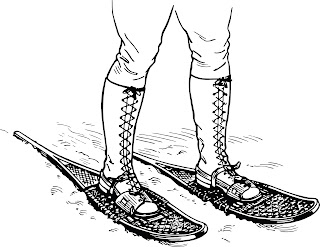
Frank Bolles, Jr. was a highly skilled wood engraver from Springfield, MA who owned a small business engaged in creating illustrations for books and magazines.   Judging from the number of articles he wrote for the national sporting magazine  Forest and Stream,  he was a frequent guest at the Fenton House during the 1870s and close personal friend of Charles Fenton. Several of Bolles’ published articles, including the one reproduced here, are literary non-fiction based on stories he was told by Fenton. Frank Bolles, Jr., “A Snow-Shoe Trip to Albany Lake,” Forest and Stream , May 6, 1875, Vol. 4, #13, p. 197.   Mr. Fenton, Carter, and Green, the last two from Massachusetts, took a fishing trip on snow-shoes to Albany Lake, March 10. Thinking it might be interesting to brother sportsmen, I give you Mr. Fenton’s account of the trip. Mr. Carter has been stopping at the Fenton House, No. 4, all winter, and has spent most of the time tramping about hunting and trappin...